
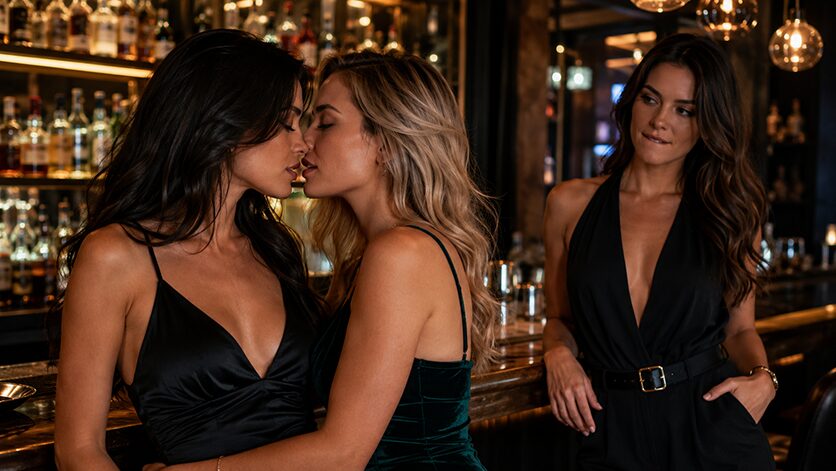
Bicurious vs Bisexual: Understanding the Difference
Bicurious and bisexual get tossed around like they mean the same thing. They don’t, quite. The two words point at different places on the same map, and figuring out which one fits you (today, not forever) can take a surprising amount of pressure off.
If you have ever stalled out wondering which label is actually yours, this is a clear, judgment-free breakdown: what each word means, where they overlap, and why you may not need to pick one at all.
The short version
Bisexual describes an orientation, an enduring attraction to more than one gender. Bicurious describes a state of exploration, an interest in same-sex attraction that you have not fully tested, named, or settled into yet.
One is mostly a description of who you are. The other is mostly a description of where you are. That single distinction is the whole thing. The rest of this article just unpacks it.
What “bisexual” actually means
Bisexual is an identity word. It names an ongoing pattern of attraction to your own gender and other genders. The attraction can be sexual, romantic, or both, and it tends to be stable enough that the person recognizes it as part of who they are rather than a passing question.
A few things bisexuality does not require, because the myths are stubborn:
- It does not require a perfect 50/50 split. Plenty of bisexual women lean heavily toward one gender and still use the word accurately.
- It does not require having dated or slept with more than one gender. Orientation is about attraction, not a résumé of experiences.
- It does not expire when you settle into a monogamous relationship. A married woman with a husband can be exactly as bisexual as a single one.
The defining feature is the steadiness. The attraction is not a thought experiment. It is just there, and it stays.
What “bicurious” actually means
Bicurious is a doorway word. It usually describes someone who currently reads as straight (or is genuinely unsure) and feels curious about same-sex attraction without having concluded much about it yet. The emphasis lives in the second half: curious. You are investigating, not announcing a verdict.
That curiosity can lead anywhere. It might open into a bisexual identity. It might confirm that you are straight and were simply honest enough to check. It might leave you somewhere with no tidy label at all, which is its own valid answer. The point is that bicurious holds the question open instead of closing it.
This is why bicurious is not a watered-down version of bisexual. It is a different stage entirely. One names a conclusion. The other names a genuine, ongoing question.
The real difference is certainty, not intensity
Here is the part people get backwards. The line between bicurious and bisexual is not about how strong the attraction is. A bicurious woman can feel a pull that knocks the wind out of her. A bisexual woman can feel something mild and matter-of-fact. Intensity is not the measure.
It helps to separate three things that rarely move in lockstep:
- Attraction is who you want.
- Behavior is what you have actually done.
- Identity is what you call yourself.
Bicurious often looks like attraction that is present, behavior that is limited or hasn’t happened yet, and an identity you have not claimed. Bisexual often looks like attraction that is present and named, with behavior that may or may not have caught up. Same raw material, different relationship to certainty and to language.
Why so many women live in the in-between
If you feel like neither word fits cleanly, you are in extremely good company, and there is research behind the feeling. Female attraction tends to be more fluid than rigid categories allow, shifting across the lifespan in ways that “gay, straight, or bi” was never built to capture. We covered this in depth in Female Sexual Fluidity: What the Science Actually Says, and it reframes the whole question.
Through that lens, “bicurious” often is not fence-sitting at all. It is an honest acknowledgment that your attractions are still moving, and that you would rather describe the truth than force yourself into a box for the sake of having a label. That is not indecision. That is accuracy.
Do you actually have to pick?
No. Labels are tools, not tests. You reach for the one that helps you understand yourself or communicate with someone, and you put it down when it stops being useful. There is no committee grading your choice.
You can be bicurious for a week or for twenty years. You can move from bicurious to bisexual, or back, or sideways into a word like queer or pansexual, or you can skip labels entirely and just live your life. And no one is owed your label, including a future partner. You share what is useful to share, on your timeline.
When “bicurious” starts to feel like “bisexual”
For some women the curiosity quietly resolves, and at some point “bisexual” stops feeling borrowed and starts feeling like a plain description. A few signs that shift might be happening:
- The attraction has stopped being hypothetical. It shows up consistently, not just in specific charged moments.
- It persists across time and across different people, rather than attaching to one particular woman.
- The word “bisexual” stops making you flinch and starts feeling accurate, even before you have acted on anything.
Worth repeating, because it trips up so many women: you do not need to have been with a woman to call yourself bisexual. Orientation describes attraction, not a checklist. If you want to explore that attraction in practice, our honest guides to what to expect your first time with a woman and how to find a female partner are good next stops. And if you explore and decide straight fits after all, that is a complete, honest answer too.
Frequently asked questions
Is bicurious just a phase?
Sometimes, and that is fine. A phase is still real while you are in it. For some women curiosity resolves back to straight, for others it opens into a lasting bisexual identity. “Phase” only sounds like an insult when people use it to dismiss you. Treated honestly, it is just one possible chapter.
Does being bicurious mean I’m secretly bisexual?
Not necessarily. Curiosity is information, not a hidden verdict. Some bicurious women discover a clear orientation underneath, others find the curiosity was the whole story. You get to find out rather than assume.
Can I call myself bisexual if I have never been with a woman?
Yes. Orientation is about attraction, not experience. If “bisexual” describes how you feel, the word is yours, virginity to women or not.
I am only attracted to one specific woman. What does that make me?
Possibly nothing that needs a label. A single strong pull toward one person is common and does not obligate you to reorganize your entire identity. Watch whether it stays specific or starts to generalize, and let that inform the language, not the other way around.
Is using “bicurious” disrespectful to bisexual people?
No, as long as you are being honest about where you are. Bicurious describes a real stage. Problems only arise when the word is used to treat queerness as a costume. Genuine exploration is not that.
What is the difference between bicurious and pansexual?
Bicurious is about your stage (still exploring). Pansexual is about the scope of attraction (drawn to people regardless of gender). They answer different questions, so a person could, in theory, be bicurious now and land on pansexual later. For a fuller rundown of the related labels (queer, heteroflexible, fluid, and more), see Bicurious vs. Bisexual vs. Pansexual.
Can I be bicurious and still be happily married to a man?
Absolutely. Curiosity about women says nothing about how much you love your husband. Many women hold both at once. How you handle it together is a conversation, not a contradiction, and the stories from women living exactly this are worth reading, like Vanessa’s.
The bottom line
Bisexual names who you are. Bicurious names where you are. Neither one is more valid, and you are allowed to wear, swap, or skip both as your understanding of yourself develops. The goal was never to win the label. The goal is to be honest with yourself, and that you can do at any stage.
If you want company while you figure it out, start with the science of sexual fluidity, read a real woman’s path in Figuring It Out at 24, or build out your own thinking with our reading list for bicurious women. Wherever you are on the map, there is no rush to arrive.